A staging copy often contains more than a design under construction. It may include customer records, private drafts and working service credentials copied from the live site. Giving it a temporary address does not make that information private.
Protect access using the mechanism appropriate to the environment, such as hosting-level authentication or a controlled network boundary. WordPress's request to discourage search engines is useful for indexing behavior, but it does not prevent a person from opening a known URL.
Decide which data the test actually needs. A layout trial rarely requires a complete customer database. Use invented or appropriately sanitized records when possible, and check that sanitization covers attachments and plugin-specific data rather than only the obvious user table.
Stop unintended external actions
A restored copy may contain scheduled emails, payment connections and automation credentials. Disable or redirect those actions through supported testing controls before the copy runs. A test environment that sends real renewal reminders can create confusion even if nobody outside the team can view it.
Keep the test site's credentials distinct from production where appropriate. If a developer needs access, grant only the access required and remove it when the task ends. Record who owns the environment and when it should be deleted or refreshed.
Be careful when pushing changes back to production. Replacing the live database with an older staging database can overwrite new orders, enquiries or editorial work. Understand exactly which files or data the deployment method transfers. A theme adjustment does not automatically justify copying every table.
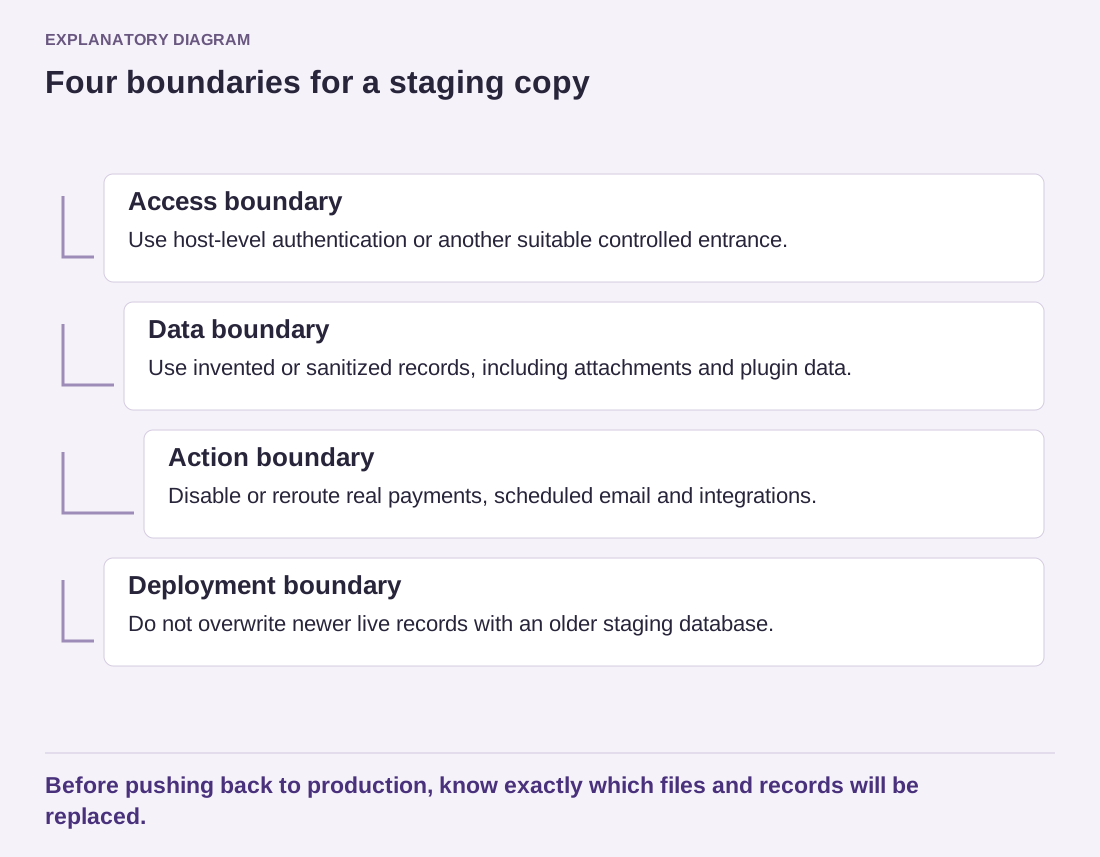
Read the diagram as text
- Access boundary: Use host-level authentication or another suitable controlled entrance.
- Data boundary: Use invented or sanitized records, including attachments and plugin data.
- Action boundary: Disable or reroute real payments, scheduled email and integrations.
- Deployment boundary: Do not overwrite newer live records with an older staging database.
Before pushing back to production, know exactly which files and records will be replaced.
Consider a membership site cloned for a new navigation design. The designer may need representative account states, but not real member names or payment references. Create invented accounts for those states and remove unnecessary copied records through a controlled preparation process. Test the logged-out, ordinary-member and administrator views separately. This gives the design review useful coverage while reducing the amount of real information carried into a temporary environment.
At the end of the project, remove obsolete copies and downloadable archives through the hosting provider's normal process. Check that old temporary addresses no longer expose the content. A staging environment is useful because it separates experimentation from the live service; its privacy, outgoing connections and deployment boundaries must preserve that separation.