The word cache appears in several WordPress settings, but the stored material is not always the same. A page cache keeps a response that can be served to a suitable request. An object cache keeps pieces of data that application code can reuse. It does not simply save a finished screenshot or another copy of the page.
WordPress has an object-cache API. Keeping that data available across separate requests requires a persistent implementation and an appropriate backing service. Installing a plugin with a familiar cache name does not prove that the hosting environment supplies that service or that the connection is correctly configured.
Ask about the whole connection
Before activating an integration, ask the host which persistent object-cache services it supports and which setup it recommends for the account. Confirm whether the connection details are supplied by the provider, how separate sites are isolated and who maintains the service. Do not copy credentials or configuration fragments from an unrelated tutorial into a production site.
If a host already manages this layer, an extra integration can create confusion rather than another independent benefit. Record the active implementation and any configuration file it uses. That record is especially useful when a developer inherits a site whose dashboard no longer tells the whole story about its caching setup.
Measure the work that might benefit
Consider a logged-in directory application that performs repeated data lookups. It may bypass a public page cache because the output depends on the current user. Reusing suitable underlying data can still be useful. A tiny brochure site whose public pages are already served from a page cache may present a different opportunity. These examples are reasons to investigate, not promises of a specific speed improvement.
Keep the database as the authoritative store. Cached values are intended to be replaceable; an object cache is not a backup and should not be the only place where important business information survives. If a plugin treats transient or cached material as essential permanent data, that behavior needs a careful review by its maintainer.
On a test copy, compare the relevant tasks before and after enabling the supported integration. Include editing and administrative work, not just an anonymous homepage request. Watch for errors and stale results as well as response times. A fast response carrying yesterday's information may point to an invalidation problem rather than a successful optimization.
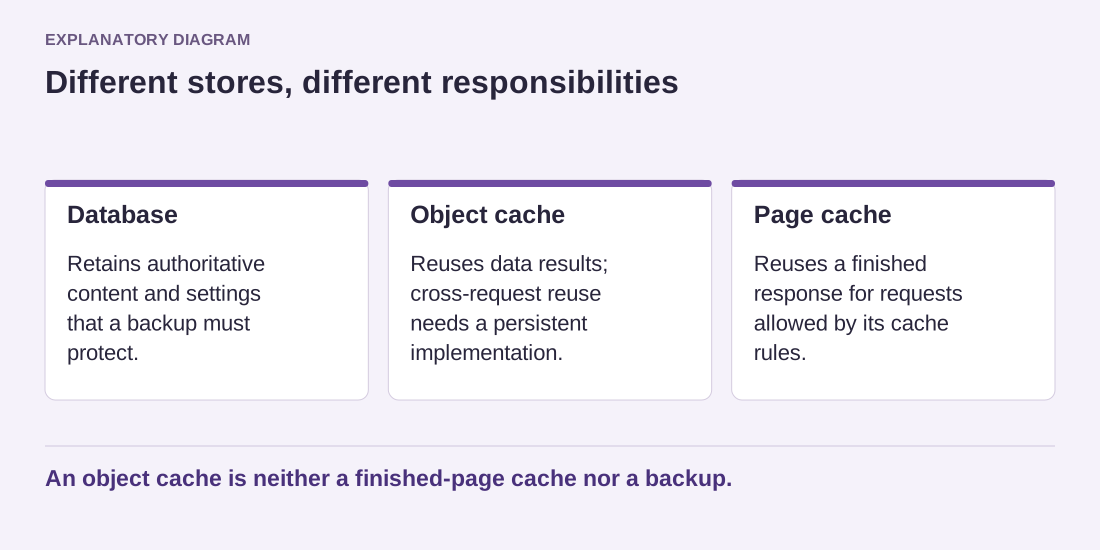
Read the diagram as text
- Database: Retains authoritative content and settings that a backup must protect.
- Object cache: Reuses data results; cross-request reuse needs a persistent implementation.
- Page cache: Reuses a finished response for requests allowed by its cache rules.
An object cache is neither a finished-page cache nor a backup.
Know the rollback before making the switch
Write down how to disable the integration cleanly using its documentation and the host's instructions. A plugin setting, a drop-in file and a service connection may be different parts of the setup. Removing one part blindly can leave another part expecting a service that is no longer available.
For a small site owner, the right decision may be to leave a host-managed configuration alone until there is evidence of a problem. Understanding the layer is useful even when you choose not to change it. It lets you ask a precise question instead of installing a second cache merely because the first one did not change a score.