A content delivery network, or CDN, can serve suitable resources from locations closer to visitors than the origin server. That makes geography part of a performance decision. A site whose readers are spread across several regions has a different delivery problem from one used mainly near its hosting location.
Begin with the affected requests. If a large image takes time to arrive from far away, distributing that resource may help. If a private application waits on a slow database operation before producing a response, an image CDN does not remove that work. The service's name is less important than which requests it actually handles.
Know what is moving through the service
Some arrangements proxy the whole website; others serve only selected assets. Find out which domains and resource types are involved, where HTTPS is terminated and how an update reaches the cached copies. A provider may offer several products under the same brand, so confirm the exact feature rather than relying on a general description.
Use a small set of representative pages and test from locations relevant to the audience. Keep conditions consistent and compare both an initial request and a repeat request. An edge location may need to fetch an uncached resource from the origin before it can reuse it. A single especially fast repeated test is not the experience of every reader.
For example, a Spanish-language publication may have readers in several Latin American countries. Testing only from a nearby office tells little about all of them. It is reasonable to compare relevant regions without pretending that one simulated location proves performance for an entire country. Connection quality and device capacity still differ within each place.
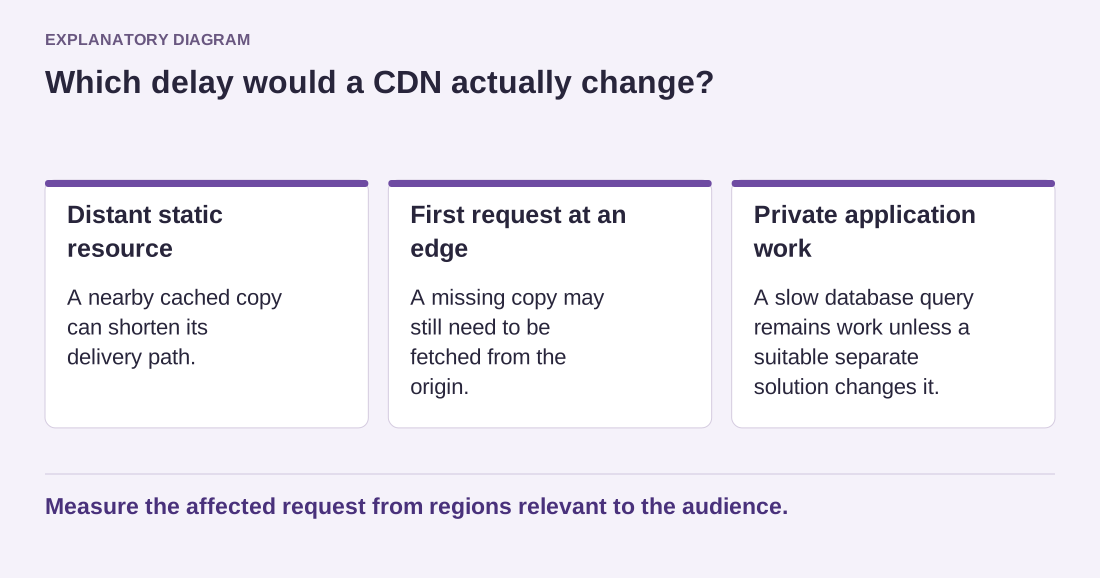
Read the diagram as text
- Distant static resource: A nearby cached copy can shorten its delivery path.
- First request at an edge: A missing copy may still need to be fetched from the origin.
- Private application work: A slow database query remains work unless a suitable separate solution changes it.
Measure the affected request from regions relevant to the audience.
Treat configuration as part of the work
Before changing DNS or delivery settings, keep the current configuration and a recovery plan. Check images, styles, scripts, forms and any private area after the change. Preserve exclusions for personalized content, and follow the application's documented cache requirements. Do not put private pages into a shared cache simply to improve a report.
A CDN also adds a service relationship to the site's data handling. Update the privacy information according to what the chosen service actually receives; do not describe a provider you have not installed. Record who can access the account and how the domain can be returned to the previous arrangement.
The decision is worthwhile when it solves a measured delivery problem and remains understandable to maintain. A faster resource path is useful, but so are correct content, predictable updates and a clear way to troubleshoot the added layer.