A pattern can save the arrangement of a useful section. The important question is whether its content should remain connected after insertion. An ordinary unsynced pattern provides a starting layout that can be edited independently. A synced pattern represents shared content whose changes can appear wherever that pattern is used.
Suppose each service page needs a heading, photograph and description arranged in the same way. The content differs for every service, so an independent pattern can provide the structure without making every page share the same words. A general contact notice used across the site may instead benefit from synchronization when its text genuinely needs to stay identical.
A short naming convention can make the distinction visible: use a descriptive name and note the shared purpose in the project instructions. Do not rely solely on a color or icon that may change between editor versions. When retiring a pattern, first inspect where it is used and what will happen to those instances. A shared announcement that has expired needs a deliberate replacement or removal plan. Deleting an entry from the pattern library is not an editorial review of every page where the announcement may have appeared.
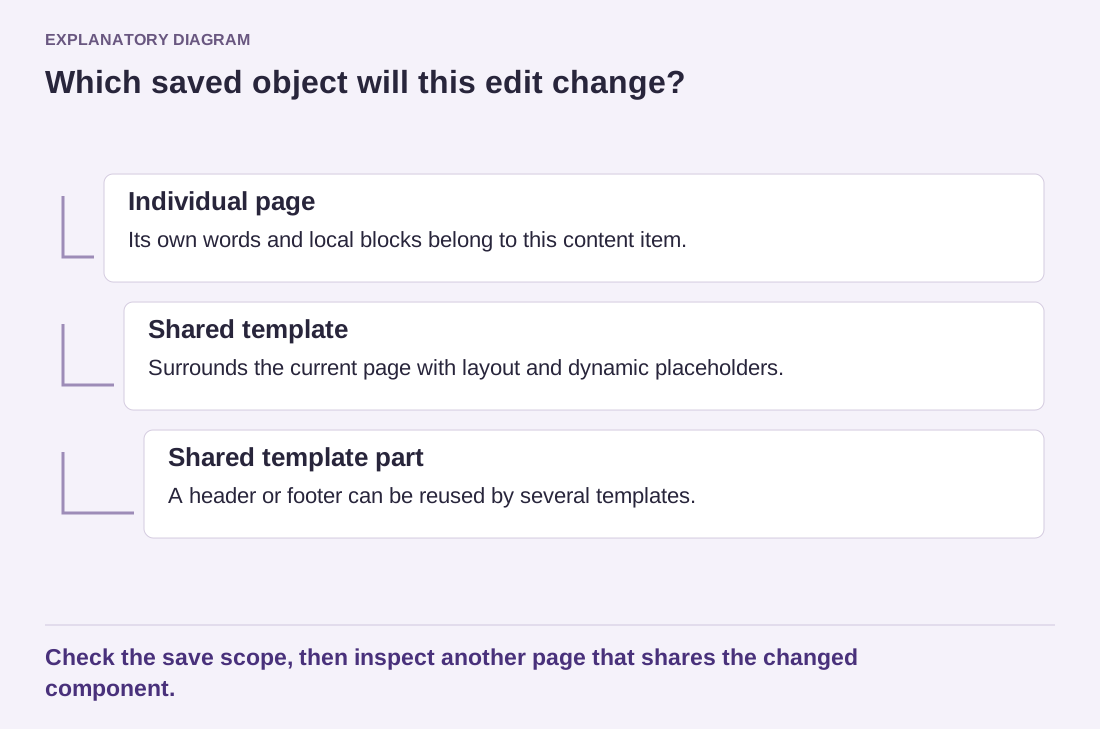
Do not choose synchronization merely because it sounds more organized. Shared content creates shared consequences. If an editor changes a telephone instruction inside a synced pattern while viewing one page, other uses may change as well. Explain that scope to anyone who will maintain the site, and give shared patterns names that describe their purpose.
Make a local exception deliberately
Where supported, detaching a synced pattern converts that instance into independent blocks. It can then be edited without changing the shared original. That independence also means future updates to the original will not reach the detached copy. Keep a reason for the exception, or the site can gradually accumulate outdated copies that look connected but are not.
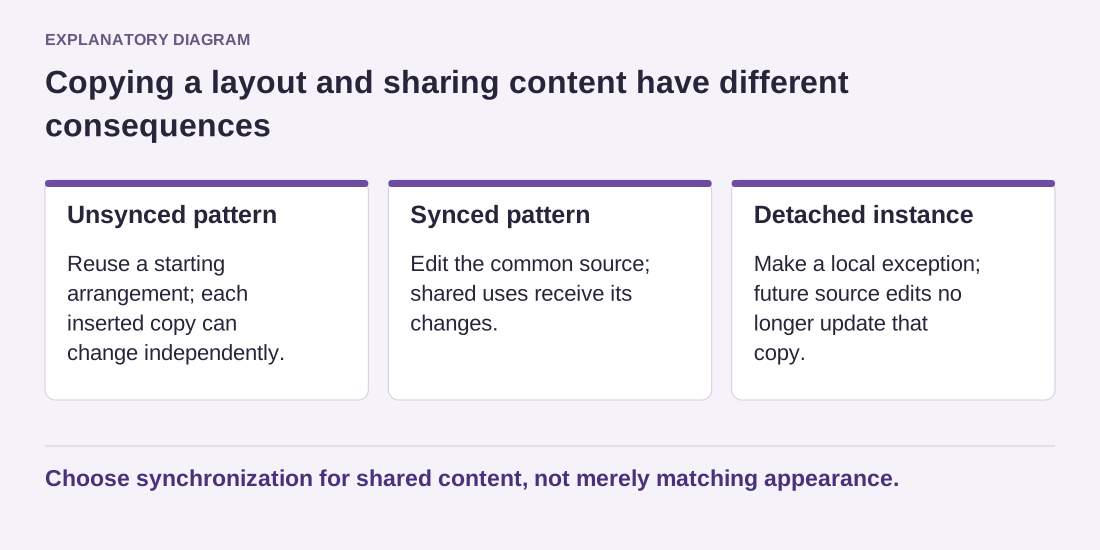
Read the diagram as text
- Unsynced pattern: Reuse a starting arrangement; each inserted copy can change independently.
- Synced pattern: Edit the common source; shared uses receive its changes.
- Detached instance: Make a local exception; future source edits no longer update that copy.
Choose synchronization for shared content, not merely matching appearance.
Some versions and pattern configurations support controlled overrides, allowing selected content to vary while other structure stays shared. Those features depend on the implementation. Do not assume every synced pattern supports them. Check the available editing controls and the current documentation before designing a workflow around exceptions.
Test the behavior with two nonpublic examples before deploying a shared pattern widely. Change one expected shared field and verify what happens in the other example. Then review the save confirmation and the public output. A small trial makes the distinction concrete for editors. Patterns are most useful when the team knows whether it is copying a design or editing a common source.