A hosting comparison becomes more useful when it describes your work rather than a list of impressive labels. A five-page service site, a busy publication and a store with customer accounts do not place the same demands on a provider. Write down what the site actually needs before deciding which plan looks inexpensive.
Start with the bill after the introductory period. Ask about renewal pricing, taxes where applicable, domain charges and separately billed services. Compare the same length of service across providers. A three-year payment advertised as a monthly rate is not equivalent to a month-to-month agreement, especially if the project is still experimental.
For a fair comparison, send the same short scenario to each provider. For instance: a small business will publish two articles a month, maintain a contact form and occasionally ask a designer to change the layout. Ask which tasks the quoted plan covers and which remain the owner’s responsibility. Save the written response, not only the sales summary. If support answers a different question, clarify it before paying. A precise answer about one ordinary workflow is often more informative than a long list of features with no explanation of who operates them.
Ask what happens on a difficult day
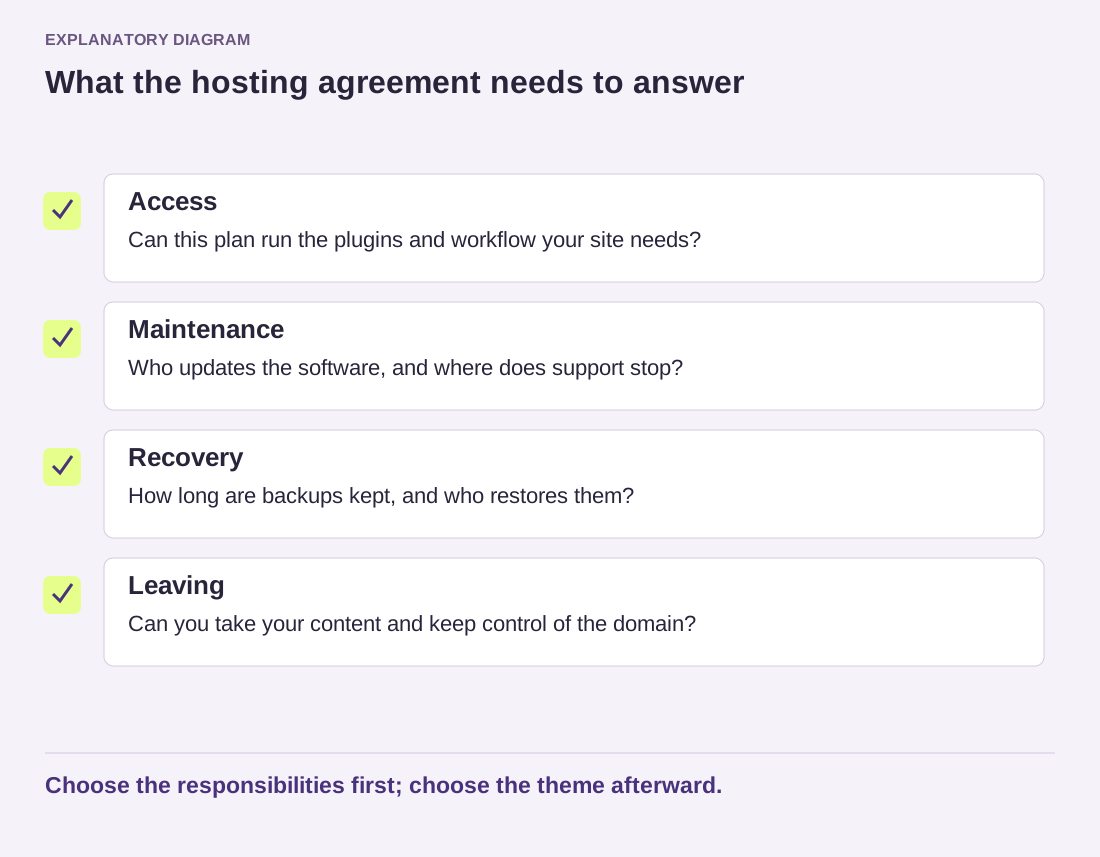
Suppose an update makes the homepage unusable. Does support investigate WordPress problems, restore a backup, or only confirm that the server is running? How do you request a restore, and does it cost extra? Ask how long backups are retained and whether you can download a copy. “Daily backup” leaves several important questions unanswered.
Find out whether a staging environment is included and what its limits are. You may need a private copy for reviewing a new design without changing the live site. Ask whether the staging address is protected from public access and whether copying it back can overwrite recent content. A staging button does not remove the need to understand what gets copied.
Resource limits deserve plain explanations. Storage space, visits, processor use and simultaneous work are different measurements. Ask what happens when a limit is reached: an extra charge, slower service, a warning or suspension. Do not assume that a large storage allowance means unlimited capacity for a busy application.
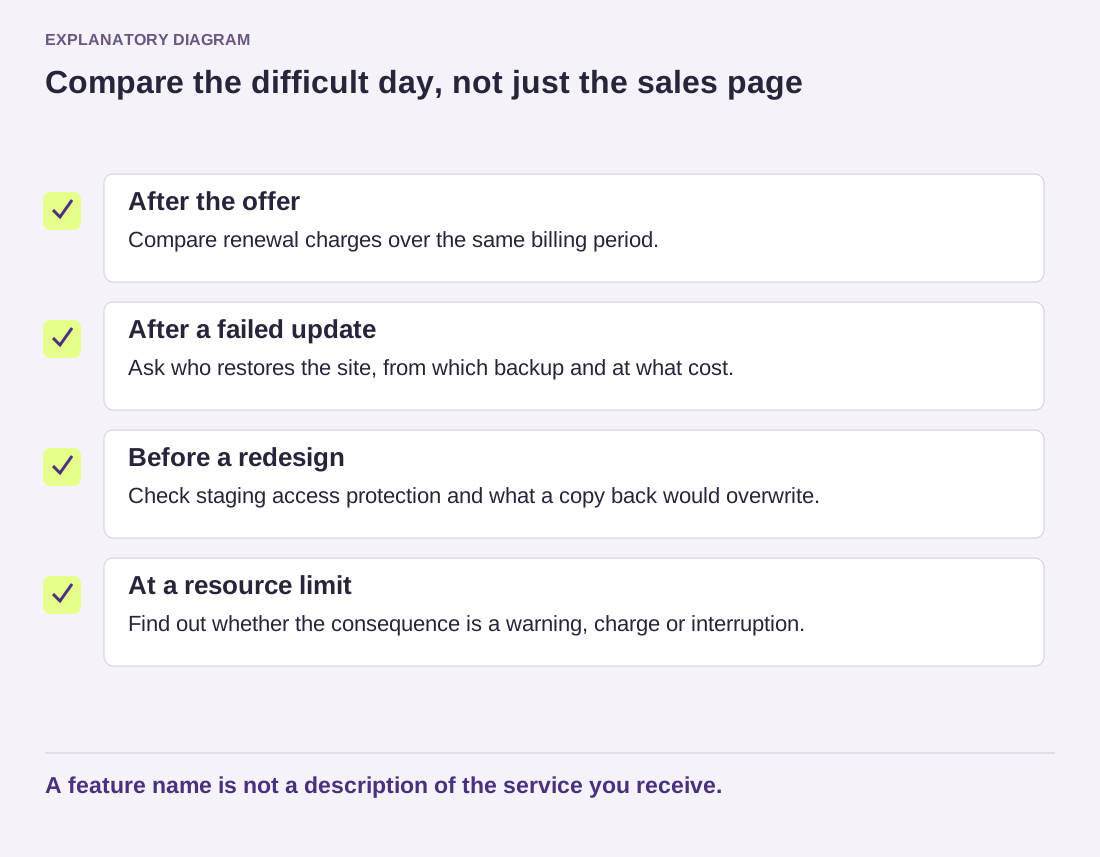
Read the diagram as text
- After the offer: Compare renewal charges over the same billing period.
- After a failed update: Ask who restores the site, from which backup and at what cost.
- Before a redesign: Check staging access protection and what a copy back would overwrite.
- At a resource limit: Find out whether the consequence is a warning, charge or interruption.
A feature name is not a description of the service you receive.
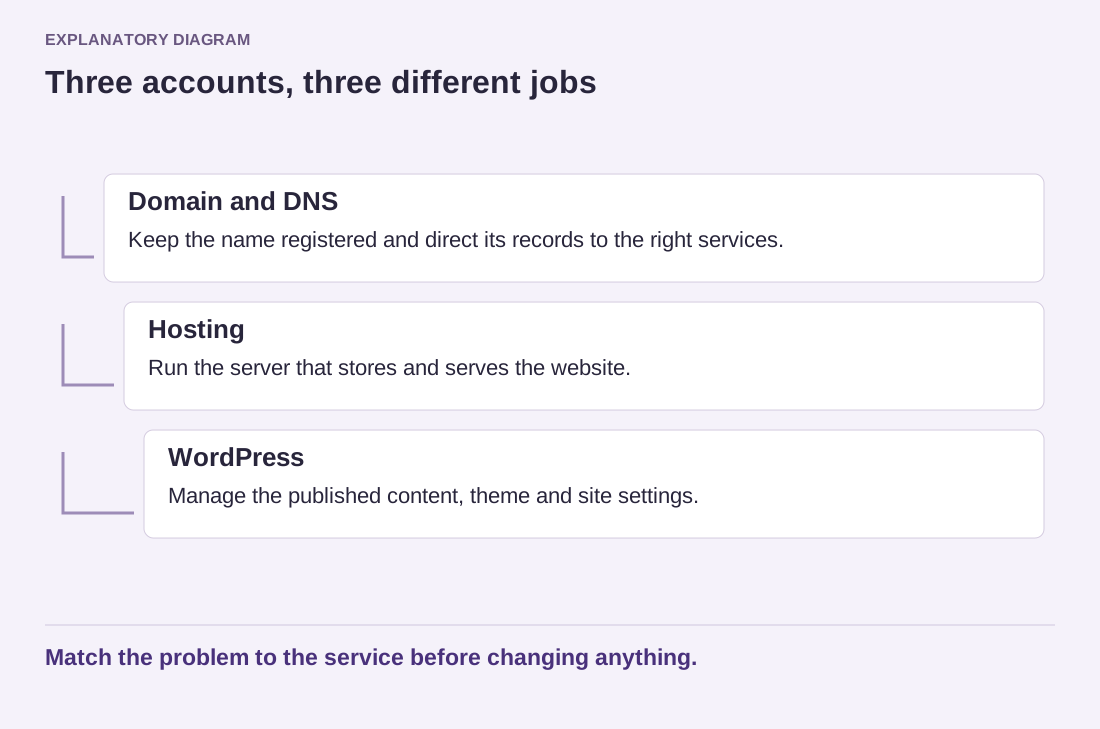
Finally, consider leaving. Can you obtain the files and database? Is domain transfer separate from hosting cancellation? Will email stop if the hosting account closes? Save the answers with the exact plan name and date, because product pages change. You are not trying to predict every future problem; you are checking whether the arrangement gives you workable options when the site grows or the service no longer fits.