A permalink is an address you expect to keep using after publication. It may appear in a newsletter, a bookmark or another website's link. Choose the overall structure while the site is new, then treat later changes as a migration task. A prettier address is not worth casually breaking established routes into the content.
WordPress offers common structures in its permalink settings and permits custom combinations. A simple post-name structure is easy to read for many small sites. Date-based structures can make sense for some publications, but dates become part of the address. Categories in URLs add another dependency if your classification changes later. There is no need to include every available piece of metadata.
Consider a guide whose title changes from Choosing a desk lamp to Choosing a desk lamp for a shared room. Its existing address may still describe the subject adequately. Keeping it avoids a needless redirect and preserves familiar links. By contrast, an article rewritten about an entirely different subject may need a different editorial decision, not simply a silent slug edit. Review whether the old resource should remain, be replaced with a clearly related successor or be retired. The address should follow the content decision rather than drive it.
Think about what readers need to recognize. An address ending in a short, descriptive subject is usually easier to communicate than a long sequence of promotional words. Keep an individual post's slug focused on its topic. The slug does not have to repeat every word in the headline, and changing a headline does not require changing an established URL.
Test before distributing links
After choosing a structure, publish a harmless test item and open it from the public site. Check a category archive and a page as well. Server configuration affects how readable URLs are handled, so a saved setting alone is not proof that every route works. If links fail, investigate the configuration rather than repeatedly trying random structures.
For an existing site, first inventory the current addresses and decide how each affected URL will reach its replacement. Redirects, internal links, sitemaps and external references need consideration. A broad change may affect many more pages than the one you are currently editing. Keep a recoverable copy and test the migration away from the live site where possible.
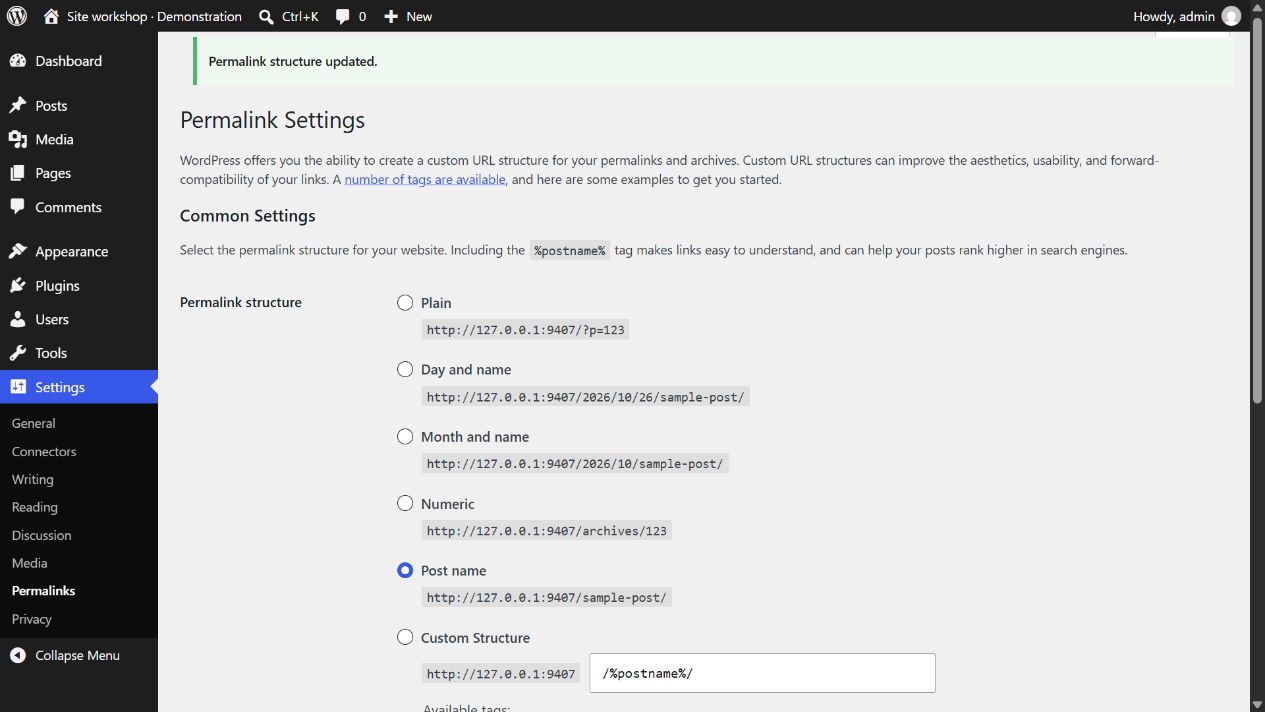
Write the chosen convention in the editorial notes. Future contributors should know how to create a sensible slug without reinventing the address system for each article. Stable, understandable links are a reader convenience. They are not a guarantee of search rankings, and adding keywords mechanically can make them less useful rather than more.